
Books to make your commute a little creepy
By Shakiya Williams
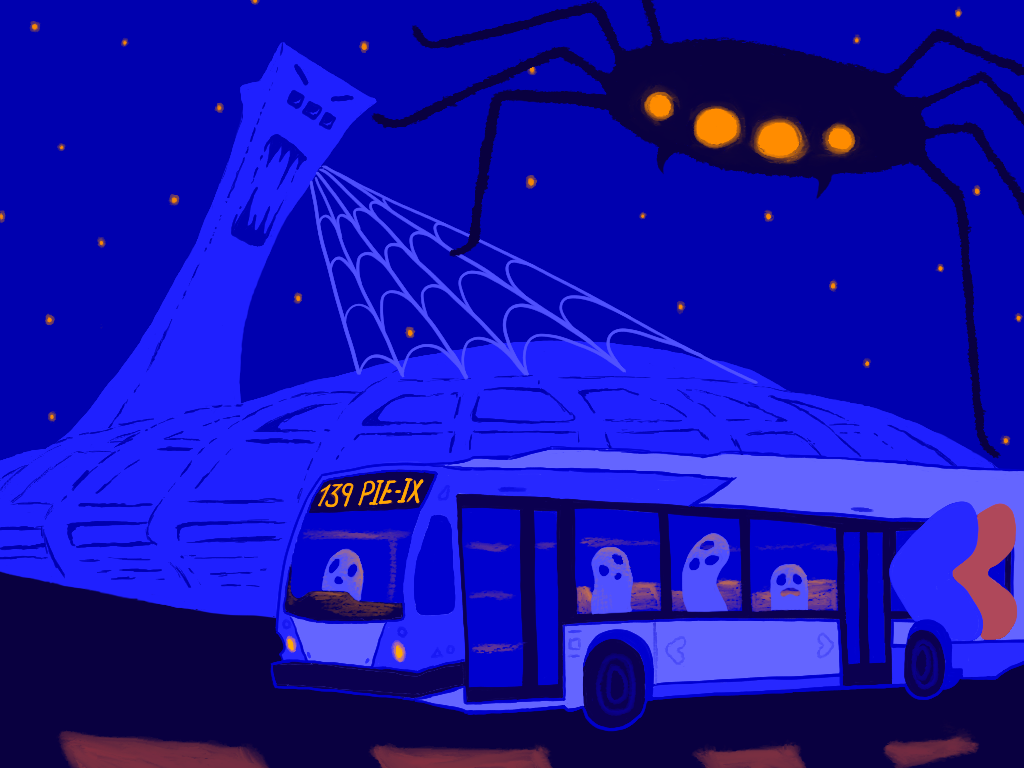
Spooky season is upon us, and during this time Montreal hums with its own weird, haunting vibes. If you’re anything like me, your fall to-be-read list is already taking shape.
This year, I went on the hunt for new horror by BIPOC and LGBTQ+ writers from Montreal and Quebec—and came up short. I went from bookstore to bookstore, searched online, and even posted on social media asking for recommendations, but couldn’t find enough to build the list I wanted. So, I did what I always do: I went searching for the horror hiding in everything else.
My favourite reads during this season are the ones that evoke a feeling of the uncanny—a quiet dread that settles within me. I don’t need a book to be shelved as horror to feel haunted; in this weather, even thrillers, YA, and realist stories tilt a little darker. I still enjoy a well-timed jumpscare, a bit of gore, and a classic trope or two used with care. But what pulls me in most are the hauntings that reflect where and how we live, stories that I wish there were more of, by queer, Black, and other racialized writers, set in the places we move through every day: metros, bike paths, tunnels, and city squares. Horror, to me, captures something raw and truthful about the world we live in.
With this in mind, I have a few recs to add to your stacks that make everyday places in Montreal feel a little more haunted. If you’re into psychological dread, multiple points of view, crime, YA, or a quieter, slow-burn kind of haunting, I’ve got you. I’ve also paired each book with a location that might make you see the places on your commute a little differently.
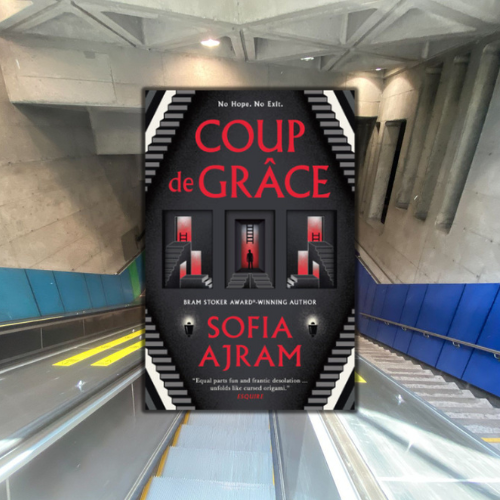
Coup de Grâce by Sofia Ajram (Penguin Random House, 2025)
📍 The metro
For: Psychological horror readers
Content warning: suicide
Sofia Ajram, a queer Montreal writer, gives us the one book on this list that lives fully in the horror genre—and a recent release at that. Coup de Grâce follows Vicken, who plans to end his life by throwing himself into the St. Lawrence River. Instead, he falls asleep on the metro and wakes at an unfamiliar terminus. When he steps off, the station loops on itself. He searches for an exit through tight corridors and cavernous rooms, but none appear. The longer he wanders, the more it feels like the place wants him to stay. And he’s not alone.
It was hard to go into the metro after this read. I kept thinking about what it would mean to be trapped there with no way out. Tiles, tunnels, fluorescent lights—this book has amazing details, even a dépanneur, with all the snacks you could think of. If you’re into a bit of gore and want something with vivid scenes that paint clear, creepy pictures in your mind, this one is for you.
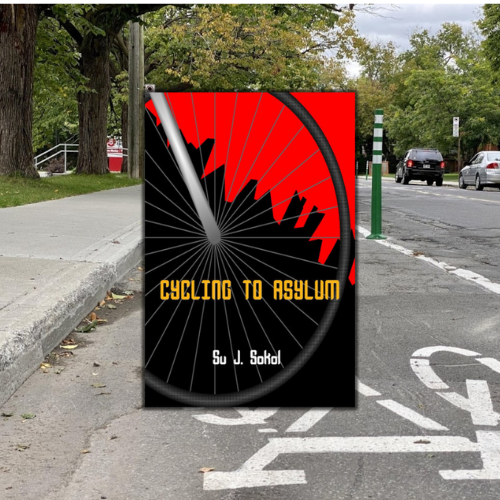
Cycling to Asylum by Su J. Sokol (Deux Voiliers Publishing, 2014)
📍 The bike path
For: Fans of multiple perspectives and political dystopia
In Cycling to Asylum, writer and social activist Su J. Sokol imagines a (too) near-future as New York slides into authoritarian rule. History teacher, Laek, can no longer hide his radical past after a violent run-in with the NYPD. He flees with his partner, Janie, and their kids, Siri and Simon. They cross the border by bicycle into Quebec, posing as eco-tourists. In Montreal, they seek asylum and must convince the authorities to grant them refugee status so they can build a new life. The story unfolds through each family member’s point of view.
Despite being written over a decade ago, this book feels uncomfortably close to home. It makes our current political climate and its trajectory feel all too real. When I see bike paths now, I see them as potential escape routes for people. Cycling to Asylum reads like a true story rather than a work of fiction.
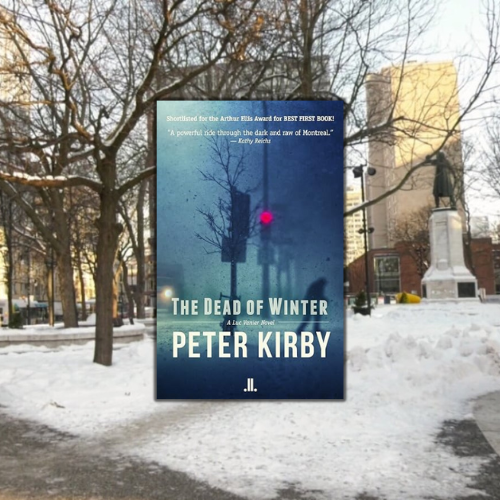
The Dead of Winter by Peter Kirby (Linda Leith Publishing, 2013)
📍 Cabot Square
For: Crime and mystery buffs
Written by Peter Kirby, best known for his Luc Vanier crime series, The Dead of Winter grounds its mystery in the city’s real streets and systems. It opens on Christmas Eve, when Inspector Vanier is called to investigate the murders of five unhoused people in Montreal. The case drags him through church backrooms, corporate boardrooms, soup kitchens, and back alleys while Montreal gets colder and colder.
This isn’t an abstract fear. It happens, and it happens here. Cabot Square is a place where vulnerable people shelter and spend time, and reading about the fictional murders made the space feel different. The novel highlights the dangers that can arise for our community members when the city fails to protect them. Visibility is not security; a public park can place a target on you for simply existing. And with winter coming, it’s even scarier to know people will have to face the cold while also worrying about staying alive.
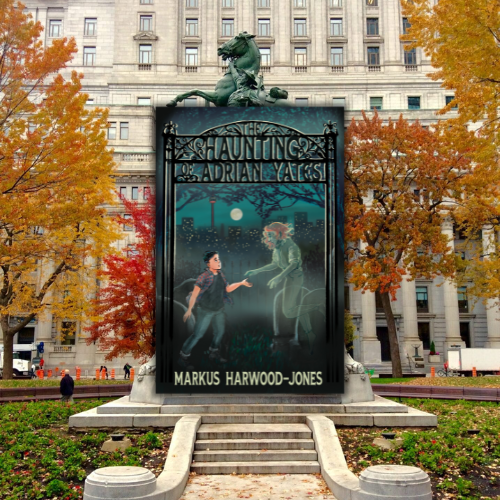
The Haunting of Adrian Yates by Markus Harwood-Jones (Metonymy Press, 2023)
📍 Dorchester Square
For: YA lovers
Markus Harwood-Jones, a queer author and longtime advocate for trans representation in YA, delivers a ghost story that’s equal parts tender and unsettling. Adrian plans a low-key summer: Slurpees with his best friend, Zoomer, and trying not to argue with his dad. Then a ghost named Sorel shows up in the graveyard near his building. Sorel gets Adrian in a way no one else does, but his behaviour is unpredictable, and Zoomer is worried. One night, Adrian and Sorel experiment with consensual possession. Adrian is sure he can handle it, until he isn’t. Then Adrian’s summer gets a little less low-key.
We walk among ghosts every day; we just don’t know it. Dorchester Square looks like a simple shortcut through downtown, but it sits over the old Saint-Antoine Catholic cemetery, where thousands of 19th-century Montrealers were buried, including victims of the 1851 Cholera epidemic. Some remains were moved; many stories stayed. After Adrian Yates, the lawn feels thinner under my feet, like there’s more below the city. I catch myself wondering what it would be like if this place could borrow me for a moment, the way Sorel borrows a body, so it could see what Montreal has become. If you walk through quietly enough, you might feel a presence walking with you.
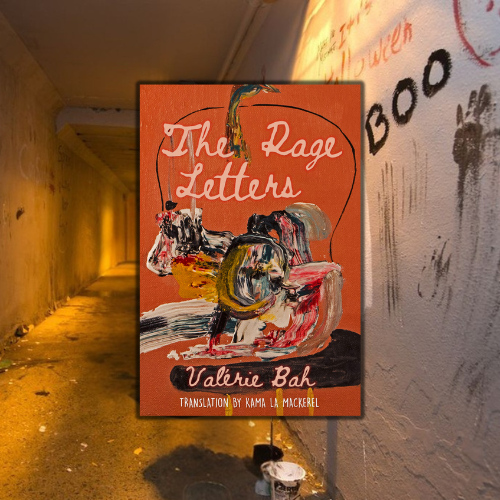
The Rage Letters by Val Bah, trans. Kama La Mackerel (Metonymy Press, 2024)
📍 Melrose Tunnel
For: Fans of slow-burning horror
Val Bah, a Black queer Montreal writer, offers a stunning collection of short stories in The Rage Letters. Translated into English by Kama La Mackerel, a Mauritian-Canadian trans writer and translator, the book follows a circle of Black, queer, and trans friends through work, love, art, and the aftershocks of social violence. Characters recur and braid together; the voice stays intimate, wry, and simmering. In their translator’s note, La Mackerel describes the language itself as “haunted, as if a ghost was attempting to manifest itself in between the words.”
For me, the haunting here is recognition and connection. Many of us Black and queer folks know these quiet rages and survivals, the parts of daily life others never have to notice. That is why the Melrose Tunnel fits. You enter from one neighbourhood and step out in another. Inside, every sound doubles back; outside, the light is a real relief. The tunnel feels like code-switching, and the translation feels like that too: a bridge that carries meaning without smoothing away its edges. After reading The Rage Letters, the hauntings and traumas of colonialism still echo in me, as they do in Bah’s writing. They are a tunnel back to memory, and a tunnel forward to the future I want for us—one where those echoes are heard, held, and answered with care.
This brings my spooky season book recs to a close. I didn’t find exactly what I was looking for, but I still found the horror I needed—the kind that hides in plain sight, that lingers in a city’s bones long after the story ends. The more I searched, the more Montreal haunted me. If you have recs by Black and other racialised writers in Montreal or Quebec working in horror, send them my way. Until then, I’ll keep finding the creepy in the everyday. Happy reading, and enjoy the season!
Shakiya Williams (she/they) is an avid horror-intaker and fall lover. She is the publishing assistant at Linda Leith Publishing and sits on the board of ELAN. They’re trying to retire the word emerging from their writer bio and are at work on a horror short-story collection—hoping it makes it a little less hard to find BIPOC horror from Montreal.
Illustration by Katie MacLean.