
By Devon Gallant
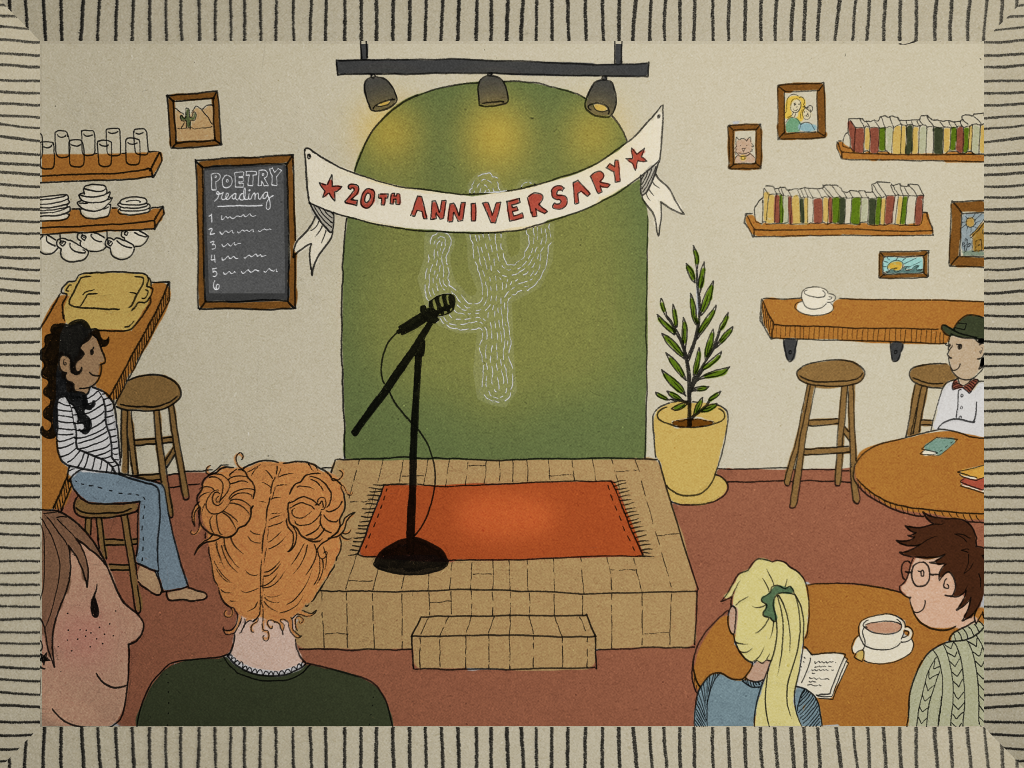
What is Cactus Press? I remember having drinks with Julie Cameron Gray one night in Toronto shortly after her chapbook The Distance Between Two Bodies launched in 2006 and telling her, oh so confidently, that Cactus would one day be as big as Coach House Books—and in only a few years, at that! Clearly, I had ambitions. Youthful and naive delusions of grandeur, we can now safely call them from a distance.
Still, throughout a rocky twenty years of highs and lows, dormancies and creative surges, the seed of Cactus Press—the idea of what it could be—has burned inside, propelling me forward regardless of what consequence or reality stood in my path.
One either has to be borderline insane or defiantly passionate to write or publish poetry for such an extended period of time. I am probably both. I look back at the trajectory of my life and it surprises. How did a press originating in the fractious weeds of the Toronto early-2000s lit-scene manage to become one of the most prolific chapbook publishers in Montreal? Stubbornness. Look back to the 2010s and Cactus seemed like just another short-lived, failure-to-launch press whose heyday was past its prime. Jim Johnstone had left the press in 2012 to start Anstruther and, aside from some exceptions, Cactus was largely dormant. What was not dormant was my belief in the press. How to proceed?
Everything fell into place in 2019 with the launch of the bilingual Accent Reading Series in Montreal, started by Acadian French-language poet Luc-Antoine Chiasson and myself. In 2013, after graduating from university, I spent nine months living in Paris where I discovered SpokenWord Paris. Hot on the heels of completing S(tars) & M(agnets), it was electric to take part in an open mic, debuting new material. In combination with James Bird and Will Cox’s Belleville Park Pages—a biweekly zine series publishing poets from the expat community in Paris—I was witnessing the momentum and synergy that a local, recurrent, community-based literary practice could achieve. A writer could arrive in Paris one week, be in print the next—and you’re sitting there watching them in the basement of the Au Chat Noir, mandatory beret on head, bohemian fingers jazz-snapping away while they read from their poem hot off the press.
I returned to Montréal with the belief that somebody should build that here. I was just determined not to do it. But as the years went by, I finally worked up the courage and recruited my colleague, Luc-Antoine—a fine artist transitioning to writer—to join me. The rest, as they say, is history.
It was an odd sense of déjà vu returning to hosting after having run the Diamond Cherry Reading Series in Toronto from 2005 to 2006. But there I was hosting Accent, and there I met James Dunnigan, whose 2019 release Wine and Fire would go on to act as a phoenix-level rebirth for Cactus. This was followed in quick succession by a slew of Montreal-based releases, including George Slobodzian’s Chez Pam Pam, Frances Pope’s The Brazen Forecast, Mirabel’s Dream Fragments, and Willow Loveday Little’s Xenia. Before you knew it, Cactus Press was in lockstep with the Accent community, and the dream that I had so far been unable to realize—one of a grassroots uprising acting in countermeasure to the literary mainstream—was starting to cohere.
It’s been a long and fruitful period, with over sixty chapbooks published from Montreal’s literary community (Cactus Press now approaching a hundred titles in its twenty-year run). Flash forward to today and the city is a veritable seething hive of literary activity, almost to the point of infamy. And although I can’t take sole credit for this newly rebounded ecosystem, Accent and Cactus were certainly a part of a broader wave that was reshaping the literary landscape of Montreal.
In retrospect, the years leading up to and surrounding Covid-19 felt like a pivot point. So much of what comprised Montreal before 2020—Matrix Magazine, the Atwater Poetry Project, Ian Ferrier’s Words and Music Show, Ilona Martonfi’s Yellow Door Poetry and Prose Reading Series—has given way to a new generation of initiatives, everything from punk-adjacent agitators Discordia and their sister-org the JRG Open Mic, to the rising stars at Yolk Literary and their massively successively Literary Oktoberfest. And so much more in between.
In 2019, I felt like Montreal needed Cactus Press. If you had asked me in 2021 or 2022 why we only published Quebec-based writers, I would have answered that we were building one of the most vibrant literary hubs in Canada. In 2026, that ecosystem is fully in bloom, and Cactus is now only one small part of what has truly become a hotbed of activity.
I find myself returning to my original passions and ambitions, both as a writer and as a publisher: to be a part of the history of poetry, the lineage of its poetic experimentation and craft. Cactus Press will always have an investment in Montreal. But for the first time in years, I feel that Cactus Press no longer needs to be of Montreal. We can simply once more be from Montréal. Which is why, as of this year, we are opening our submission policy to include residents from all over Canada.
There is an irony to the unique place Cactus Press finds itself. Because we invested so heavily in the local community, we invariably published a large number of writers emerging out of Concordia’s Creative Writing program (and out of the Concordia/McGill university ecosystems in general). Not by design, simply by circumstance. It’s comical that Cactus Press—whose modus operandi is to create a grassroots ladder into the literary world—found itself increasingly becoming a de facto stepping stone for career-track writers passing through a fine arts system.
There’s nothing wrong with publishing a writer who studied creative writing (it’s been our great pleasure to do so!). However, it would be a tragic misreading of Cactus Press’s core aims and ambitions if one were to view our agenda as complicit in the type of credentialism that often goes hand in hand with that world. I call it tragic because those aren’t the values I want to inspire in the next generation of writers.
I want writers to have faith in their writing, to have faith in each other, and to support one another. I want writers to be passionate about their craft and be weird and wild and obscure and strange. I want writers to place greater importance on the work itself than the outward markers of success that so often take centre stage in this social media economy we find ourselves in. I don’t want Cactus Press to be co-opted into a credentialism infrastructure. And I would hate for the press to be viewed as only a stepping stone, hoop to jump, or box to check. I think that would be entirely missing the point.
Why publish chapbooks? I find this question hard to answer. Why indeed! They are so ephemeral. Unlikely to be found on the shelves of a used bookstore decades from now. Every writer has a different motivation for writing a chapbook and every publisher has a different motivation for publishing one. For Cactus Press, chapbooks are foundational to our genesis, but even after twenty years in publishing, they are still rewarding projects. I think that’s because there is something inherently communal and “of the people” about a chapbook. They live in the thick of it. That’s reason enough.
It is standard practice when composing submission guidelines to give the reader a sense of the organization and what it is looking for. I always struggle with this. Most of the time, these guidelines are so vaguely poetic and cryptic as to be virtually meaningless, or otherwise they seem to be building a wall that tells all prospective writers why they should not submit.
I prefer to simply say that we are looking for poetry. Period. If I were to presuppose that I knew exactly what type of work I was looking for, that would kind of defeat the purpose, no?
Rather, there’s a phrase that I’ve been developing: ‘Cactus Press is less an experimental publisher and more a press that likes to experiment with what we publish.’
“Experimental” in the context of publishing can feel like a kind of code word for “academic,” often tied to work that originates from and is indebted to that infrastructure. I prefer to think of Cactus Press as experimental in the most playful sense of the word. We’re interested in everything from lyric poetry straight through to concrete and abstract. And everything in between.
Cactus Press has also been experimenting with publishing longer works. We tested the waters in 2022 with Willow Loveday Little’s Vice (Viscera) and again in 2025 with Jerome Ramcharitar’s The Riddle of Three Crimson Doors. Both successful projects, in their own way, but they made me confront the limitations of running a press as plucky as mine.
Publishing full-length really behooves you to have an established distribution system, as well as the resources to supply promotional copies, apply to awards submissions, and support and market a book after publication. These aren’t insignificant challenges for a press that already has their dance card full of chapbook projects and local engagements each year. I had more or less decided after Jerome’s book that Cactus was not ready to become a full-length publisher. Better off staying a big fish in a small pond.
But then an idea took hold of me: Not quite a full-length, more than a chapbook. Something in the vein of the City Lights Pocket Poets Series. I started off calling it “chapbook+.”
Launched this year, Prickly Exports is our small, perfect-bound pocket poetry imprint at Cactus Press, published alongside our chapbook series. The inaugural roster includes 666 5th Ave by Simon Occulis, In the Palace of the Present Moment by IF the Poet, and two forthcoming December releases: Heterotopia by Kevin Andrew Heslop and Mondo Tomorrow by Derek Godin. Add to these two to four titles planned annually for the foreseeable future, or at least until they drive a stake through my heart.
Do I believe this imprint can or will have the cultural impact of the City Lights Pocket Poets series? No. Do I believe there is a niche to fill, some undefined nook that I am still not fully aware of, that I plan to burrow my little publishing-self into? Maybe.
Hubris? Possibly.
But the thing that my time in Montreal has taught me, is that I’m in my Field of Dreams era: “If I build it, they will come.”
And so, after twenty years, here I am, pulling a full Jerry Maguire, with ziplock bag full of goldfish in hand, saying:
“It’s not a memo, it’s a mission statement. Who’s coming?”
—Devon Gallant
Montréal, 2026
Illustration by Holly Loughton.