
by Paisley Conrad
Founded in 2016 through an initiative spearheaded by then-Head Librarian at Concordia University Guylaine Beaudry and founding Director Geoffrey Little, Concordia University Press is celebrating its tenth year with seven publication series in production, and twenty-five books published. I sat down with its current Director, Ryan Van Huijstee, who joined the team in 2019 as the Acquisitions Editor, to reflect on the last decade of Montréal’s only fully open-access, non-profit scholarly press.
Read Quebec: How was Concordia University Press founded?
Ryan Van Huijstee: The time felt right, I think, in 2016, when Concordia was going through a growth period, to develop an open-access publisher. The library at Concordia was the prime mover on this. It was Guylaine Beaudry, who’s now the Dean of Libraries at McGill, and Geoffrey Little, who’s now the Dean of Libraries over at the University of Western Ontario. Librarians are behind this effort, which is to produce more open-access book scholarship. This is to make information that’s substantiated, verified, and peer-reviewed by the best scholars in the world available to the public for free to better inform critical discussions and assessments. Certainly, this is a time of a lot of misinformation and disinformation.
I joined in 2019, right before the first book. At that point, we only had canvas bags and no books to put them in. Our first book was Ken Lum’s [Everything is Relevant: Writings on Art and Life, 1991–2018], which came out in January 2020. What could go wrong? Everything shuts down, right? It was a funny moment because it did, in some ways, allow us to hunker down and develop more works. This fall, we’re publishing our twenty-fifth book since 2020!
RQ: The press has a strong focus on built spaces, art, and expansive definitions of what media is. Is that a part of the press’s mandate?
RVH: We wanted to position art writing by artists as a form of scholarly and critical production. There was an early interest in experimenting and playing with the margins of what counts as scholarly publishing. When you’re a new publisher, you want to make it clear to the outside world what you’re interested in, so people start bringing you submissions. It’s a challenge to start off and then try to figure out how you form and present an identity. For us, this was through visual culture, gender and sexuality studies, media studies, architecture, social history, cultural history, these sorts of areas.
We’ve also been thinking consciously of what kinds of books we want to publish if we’re also giving them away for free. We want to make that material accessible to anybody with an internet connection, but we also want to support a thriving print culture, which is reflected in the design work. It also helps to subsidize and support the cost of giving it away for free. If you produce these beautiful editions, people still want to buy them.
RQ: Some books like Lauren Beck’s Canada’s Place Names and How to Change Them are scholarly volumes but have also circulated widely outside of academic circles. Can you say more about that?
RVH: Lauren keeps getting interviewed lately because of the Lake Ontario renaming. It’s an issue that she’s looking at through a historical lens. Names will continue to be revisited and changed for a range of different reasons, which she outlines well in that book. That was a book that connected with public readership, in part because of the topicality.
I like to think of scholarly publishing as slow publishing, but it’s worthwhile because it’s substantiated, rather than just reactive to a present tense, one that is often just a current event that’s constantly getting swept up in another current.
The cover is by Sébastien Aubin. That book won a cover design mention for the Association of University Presses Book, Jacket, and Journal Show. He took a Jean de Brébeuf map from the seventeenth century and took these bodies of water and foregrounded them as the central feature, instead of the land being the central feature. He wanted to subvert and change it, and as an Indigenous designer, he wanted to foreground waterways as the central methods of communication and transport. Then he also inverted the image, to make it familiar but unfamiliar.
RQ: How does the Press interface with the challenges and the affordances of a place like Montréal, a multilingual space?
RVH: It’s one of the most curious and distinct places in the world, and we all get to benefit from that. As a result of these kinds of collisions of cultural environments, you get the sort of interest in interdisciplinary work and experience. It’s a culture that loves culture. I’ve lived in four provinces in Canada, and nowhere is art, and literature, and music more prominent than here. The amount of public art here is incredible, and we benefit from that as an open-access publisher that also gets to produce all this work and give it to the public for free.
We’re also very lucky that we’re a university press in a city that has so many universities, so many students, and so many researchers, as well as other institutions that are interested in research and developing writing, whether that’s the museums or with our colleagues at the Canadian Centre for Architecture.
RQ: What is a day like here at the Concordia University Press?
RVH: The day can really change. Often, we will be doing a public event, tabling at a book fair, here or elsewhere. There’s a lot of time spent reading on a computer. We’ve been fortunate to do a lot of in-house editing, whether that’s developmental editing or copyediting. We collaborate on a lot of things because we’re a small staff. We all get to do a little bit of everything.
One of the best days I ever had in publishing was in November 2022. We were coming out of lockdowns and finally returning to in-person living. It was the Read Quebec Book Fair, and it was happening in the Concordia [Webster Library] Atrium. We had two books show up from the printer on the same day. It was Lauren Beck’s Canada’s Place Names and How to Change Them and Alex D. Ketchum’s Ingredients for Revolution.
I got to open the boxes, inspect the printer’s work, say that I thought it was very good, release them, and then take the books immediately downstairs and sell them at a public book fair. Alex got to come by because she was local and was literally signing books within two hours of us releasing it.
RQ: What will the next decade of the Press bring?
RVH: More books. More fun books! I think some things have been gradually changing over the last couple years, where before people said, “Oh, I didn’t know Concordia had a university press.” Now it’s, “Oh, I’ve got that book, and I really like it.”
We have a great book coming out that is called Climate Change Cookery: Recipes and Resilience in England’s Little Ice Age, 1550–1700 [by Madeline Bassnett], which looks at this period where there was a small glaciation and the Thames kept freezing over. She is looking at how the first recipe collections, English cookbooks, were recording the weather and famine, intemperate climate and unexpected weather, and how these were affecting food practices. It’s a funny parallel, because it’s a through-the-looking-glass thing where, obviously, we’re on fire right now, but they were freezing. It’s a fun, thoughtful, beautifully written scholarly work.
Paisley Conrad is a writer and critic. She lives in Montréal.
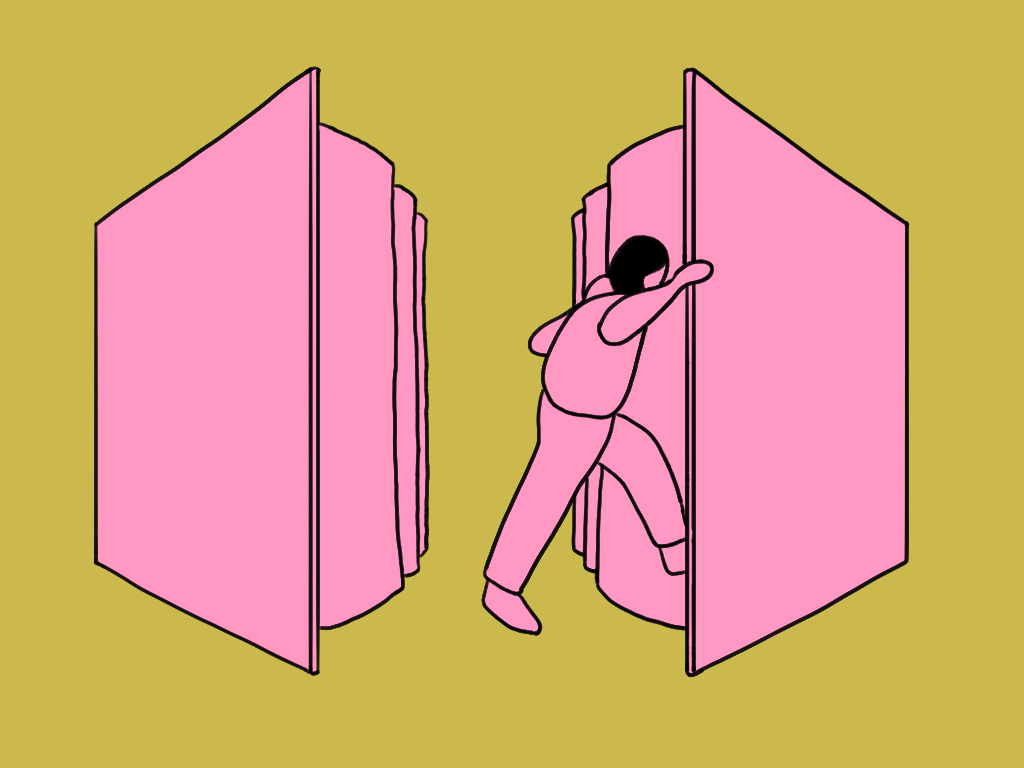
Illustration by Oliver Gadoury.